
All Things Must Pass
a history of HandMade Films

This is part one of a two-part article and is free to all. The second part, which will be published in next week’s issue, is for paid subscribers.
"DON’T MENTION The Beatles again - don’t mention the Beatles!”
I often catch myself dropping some Beatles-related morsel into one of my articles, only to fish it out again during the editing process for fear of appearing predictable or, God forbid, obsessed. I haven’t been obsessed with The Beatles since my tender years, but they often enter my mind when I’m writing about cultural matters. It’s not really surprising - their impact on the arts was immense. Despite them appearing in a clutch of movies together, and several more singly, one would have thought that a piece about a British film production company would surely be a Beatle-free zone. Unfortunately, one of them had to go and save the British film industry. Oh well, I might as well surrender to the inevitable...
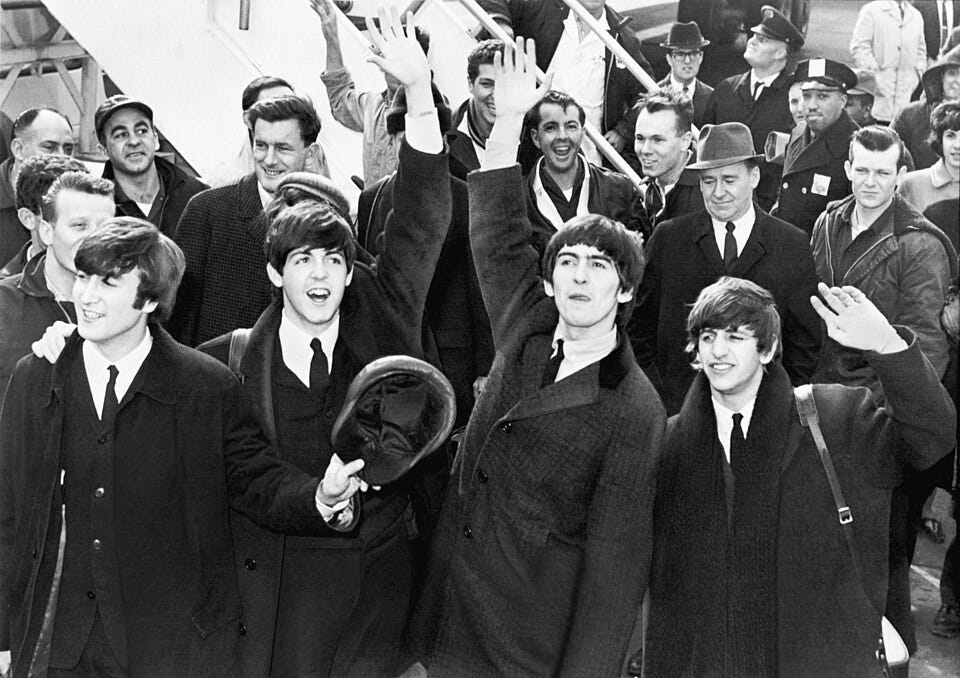
After The Beatles split in 1970, the fastest out of the blocks was not, as one might expect, John Lennon or Paul McCartney, but the “Quiet One”, George Harrison. His debut solo album, All Things Must Pass (1970), far outsold the respective solo debuts of both of his supremely gifted confrères, and has done ever since. Not only did he outperform Lennon and McCartney in record sales in those early days, but being possessed of a restless mind and a generous spirit, he inadvertently branched out into a highly significant career as a film producer. There was a rocky road ahead, but his company, which he named HandMade Films, produced some notable movies over an eleven-year period, at a time when the British film industry was fighting for its life. Beginning with Monty Python’s Life of Brian in 1979 and ending with Nuns on the Run in 1990, twenty-three feature films were produced under Harrison’s leadership, including projects as diverse as Time Bandits (1981), Scrubbers (1982) and A Private Function (1984).
The story begins in 1975, when Harrison was in Los Angeles attending an advance screening of Monty Python and the Holy Grail. It was made by the team responsible for Monty Python’s Flying Circus, a surreal British TV comedy show that ran from 1969 to 1974, featuring Eric Idle, John Cleese, Michael Palin, Terry Jones, Graham Chapman and Terry Gilliam. Monty Python and the Holy Grail, a sendup of Arthurian legend, was the team’s second movie. Eric Idle, who was at the screening, was told that George Harrison, a Python fan, was in the audience and wanted to meet him. They hit it off immediately, partied for days, and it was the beginning of a close friendship that lasted until Harrison’s death. He appeared in the Christmas 1975 episode of Idle’s Rutland Weekend Television, a comedy series which was commissioned following the huge success of Monty Python’s Flying Circus. He became close to all five of the Pythons, but had a special bond with Idle, and it was to him that Idle turned when the Pythons were desperately looking for a way out of a very deep hole.
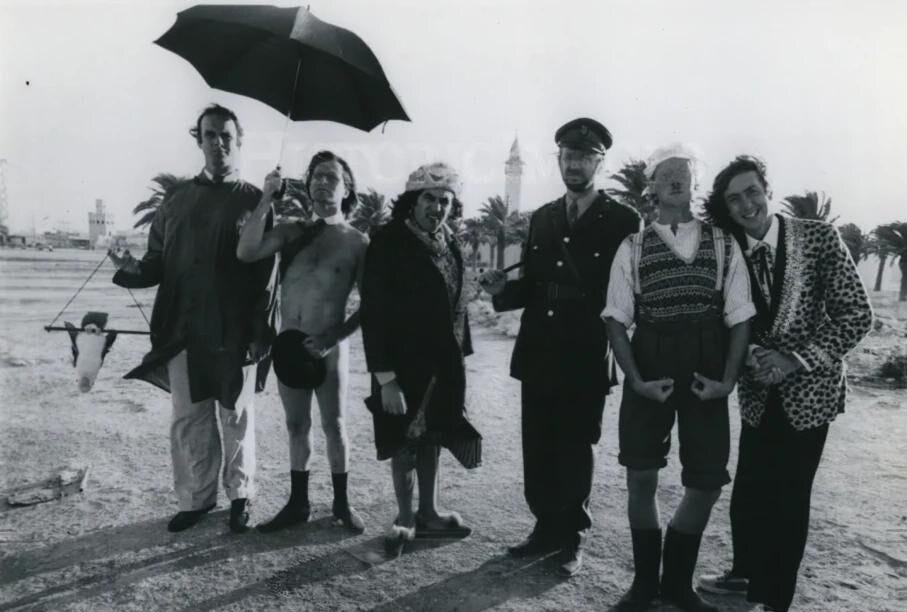
It was 1978, and the Pythons were on location in Tunisia. There were two days to go before they were due to begin filming their epic comedy masterpiece, Monty Python’s Life of Brian. The cast was assembled, the sets had been built and the cameras were ready to roll. The production was being financed by EMI under Bernard Delfont, who made a last-minute decision to read through the script, and promptly backed out of the project. He feared that the film would be perceived as blasphemous. He wasn’t wrong: after its release, Life of Brian was deemed sacrilegious by some ill-informed commentators, some of whom hadn’t even seen it. The Pythons protested, and maintained that the film was not intended to mock Christ, whom they considered to be a good man and, importantly for a comedy film, not a particularly funny target. Instead they had created a character called Brian who is mistaken for the Messiah, the comedy being generated by the farcical situations arising from the misunderstanding. A reasonable person would probably have considered this to be a substantial weakness in the blasphemy argument, but that didn’t wash with those determined to find offence. “I’m not going to have people thinking I’m mocking Jesus Christ,” said Delfont, and pulled the plug.
The panic induced by this high-handed and extremely late decision can be imagined. The Pythons began frantically searching for alternative funding, and Idle rang Harrison and explained their predicament. His friend promised to have a word with his business manager, an American lawyer named Denis O’Brien, who had been recommended to him by the comedian Peter Sellers. A few days later, Harrison relayed the good news that he and O’Brien had raised the money to save the film. It comprised a private loan of £400,000, and a bank loan secured on Friar Park, Harrison’s beloved Victorian mansion in Henley-on-Thames and O’Brien’s company premises at 26 Cadogan Square in London. When asked what prompted this reckless act, Harrison replied, "I just wanted to see the film”. Whether he realised it or not, it was the first step in his career as a film producer.
“If something’s really good it deserves to be made.” George Harrison.
Life of Brian was released in 1979. Predictably, it ignited a furore that rocked the British establishment. It was initially given an AA1 certificate by the British Board of Film Censors.2 This was raised to an X certificate3 by twenty-eight UK local authorities, and eleven more banned it outright. It is perhaps a sign of changing social mores that it now has a 12A rating.4 On its release there were protests and debates, and across the Atlantic it was banned in several US states. As so often happens in such circumstances, the outcry prompted massive public curiosity, and the film was a huge success, grossing more than $20,000,000 in the US alone. By taking a huge financial risk to bail out his friends, Harrison had enabled the creation of one of the greatest comedy films of all time and, as it turned out, founded a leading British independent film production company in the process.
"For me to make films is my way to help other people.” George Harrison.
George was a reluctant movie mogul, but he missed being in a band, and in a way, HandMade Films filled that gap. He loved the Pythons, and even made a brief appearance in Life of Brian, as he would in other HandMade productions. He’d said that he just wanted to see the film made, and as Eric Idle remarked, “It was the most expensive movie ticket in history”. Having enjoyed such success with his debut as producer, he saw the potential to help other filmmakers, and it seemed that in Denis O’Brien he had a business partner who could help make that happen. O’Brien had earned his trust by helping him to get back on his feet financially after the painful breakup of The Beatles, and with his help Harrison would become one of the most daring producers in British cinema.
After Life of Brian, the company started to expand. During the early nineteen-eighties, as HandMade was getting to its feet, British cinema was in deep crisis. Given this difficult environment it is all the more creditable that Harrison refused to let creative decisions be made by committees and executives, believing in complete artistic freedom for filmmakers. HandMade backed projects that major studios considered impossible. For a time, this faith in the freedom of the artist was allowed to shine, yielding movies of a quality and range that assured them of a place in the history of the British film industry. The hit rate was enviable. The company had an excellent Head of Production in Ray Cooper, who also happened to be a respected percussionist. He was an old friend of Harrison’s, and the first significant HandMade appointment. It was an extraordinary leap from playing drums for Elton John and others, to having a vital role in a film production company, and he was apparently offered the position on the basis that he had some acting experience. It was a tenuous reason to give him such an important position, but as it turned out, a good decision.
The second HandMade movie was a film noir directed by John Mackenzie. The Long Good Friday (1980) starred Bob Hoskins. It came into the company’s orbit when Eric Idle met Hoskins at a party, and it was picked up after being slated for a television release by ITC.5 On viewing his new purchase for the first time, Harrison remarked that he would never have approved such a violent movie had it begun at HandMade, but it did well in the US, and was once voted the best British gangster film of all time. It scored another hit for the company, and Time Bandits, the third project, continued the winning streak. Directed by that master of the surreal, Terry Gilliam, it was not a Python movie per se, although some of the team did make an appearance. Gilliam also designed the HandMade logo, and many of the company’s activities, such as poster design and marketing strategy, were kept in-house. It seemed that George really had found a new band.
Naturally, the complete HandMade filmography is a mixed bag. Productions range from the obscure to the successful, the well-loved and the notable. You may have heard of Scrubbers, a prison movie co-written and directed by Mai Zetterling; A Private Function, a post World War II comedy whose central character is a pig; Mona Lisa (1986), a thriller; Withnail and I (1987) and Nuns on the Run, two comedies. Some actors and directors returned to the fold multiple times, among them Bob Hoskins, who was involved in four productions, and was positively showered with awards for his role in Mona Lisa. Maggie Smith won BAFTAs for The Lonely Passion of Judith Hearne (1987) and A Private Function, in which she appeared with Michael Palin. They also appeared together in The Missionary (1982), directed by Richard Loncraine.
A Private Function was written by Alan Bennett and it’s the only movie I know of whose crew included a Bucket Boy. You can probably guess what his job was. You may have noticed the wonderful Richard Griffiths in the trailer. He was another HandMade regular, appearing in this and two other productions, Withnail and I as the creepy, hammy Uncle Monty, and the ill-fated Shanghai Surprise (1986).
Sundry Pythons also popped up regularly. Apart from Life of Brian and Monty Python Live at the Hollywood Bowl (1982), Michael Palin appeared in Time Bandits, which he co-wrote with its director Terry Gilliam, starred in A Private Function, and played the title role in The Missionary, for which he also wrote the screenplay. John Cleese had roles in Time Bandits and Privates on Parade (1982), while Eric Idle’s third appearance in a HandMade production was Nuns on the Run, in which he co-starred with Robbie Coltrane. Coltrane also appeared in Scrubbers and Mona Lisa. On it goes, like a creative chain reaction. It would appear that actors generally had a positive experience working on HandMade productions, although it is possible that a shortage of opportunities in a struggling industry was a factor in their willingness to return.
Next week, not all surprises are fun. There are turbulent times ahead…
Thank you for reading part one of the story of HandMade Films. If you enjoyed it and would like to support The Dialectic you can do so by clicking the ❤️. You can also become a free or paid subscriber, share this post, or leave a one-off tip. Thank you for supporting human creativity.
Photo credits:
The Beatles arrive at JFK Airport, 1964. United Press International, photographer unknown.
Publicity photo of all six members of Monty Python in Monastir, Tunisia, 1978. L-R: John Cleese, Terry Gilliam, Terry Jones, Graham Chapman, Michael Palin and Eric Idle. Distributed by Arista Records.
All photos public domain, via Wikimedia Commons.
Sources: HandMade films - An Accidental Film Studio by Modern Films; Music Box USA YouTube channel How George Harrison Lost a Fortune Saving a Movie (The True Story of HandMade Films); George Harrison The Reluctant Beatle by Philip Norman; Discogs; Very Naughty Boys: The Amazing True Story of Handmade Films by Robert Sellers; BBC News bbc.co.uk Why Monty Python’s Life of Brian, once rated X, is now a 12A,17/7/20; British Board of Film Classification bbfc.co.uk; IMDb; More than Likely: A Memoir, by Dick Clement; BFI Screenonline.
Not suitable for children under fourteen.
Now the British Board of Film Classification.
Not suitable for children under eighteen.
Not generally suitable for children under twelve. No one younger than twelve may be permitted to attend a 12A cinema screening unless accompanied by an adult.
The Incorporated Television Company provided drama and occasionally comedies for the ITV network. Under the leadership of Lew Grade, who was the Brother of Python Nemesis Bernard Delfont, it specialised in action and adventure series.
Fabulous. I feel like a heretic for not loving the Beatles that much, but I do like and respect them immensely and George was always my favourite. Your writing is so engaging Jules that you could make washing up sound magical. I didn't know any of the history of Handmade films and this was so interesting. I love the Time Bandits too. Great post and I look forward to part 2.
Excellent read! I never knew Ray Cooper was part of it, that was a surprise! I’m just finishing off a Beatles related post myself. Trying to get the obsession out of my system for the walk we’re doing in April. Then it will be post punk all the way! Can’t wait for your second episode!