
BLAST
how Vorticism anticipated the forces that crushed it

A LONG time ago, during a visit to the Tate Gallery in Liverpool, I wandered into a small annex off one of the main display areas. There I found some sculptures by the French artist Henri Gaudier-Brzeska. It was one of those unusual moments when you experience a connection so intense that it feels like a key fitting into its lock. It’s odd that I can’t remember the pieces with any clarity, but I do remember the feeling, which was one of total absorption; a rare pleasure. I left with some reluctance, and was dismayed when I later discovered that the artist had died during the First World War, not long after he had made the items I had been admiring. I felt the tragedy of that very keenly.
The human cost of war is sickening, and the concomitant loss of talent in all fields makes the sum total of suffering and waste mind-boggling in its immensity. How many brilliant people, mostly men, have been slaughtered on the field of battle, and what might their contribution to human existence have been had they lived? Henri Gaudier-Brzeska was just one example. Whenever I encounter his work my heart sings, but the song is marred by a thrum of dread and sorrow, that terrible knowledge of a life stolen. He was killed in action in 1915 at the age of twenty-three.
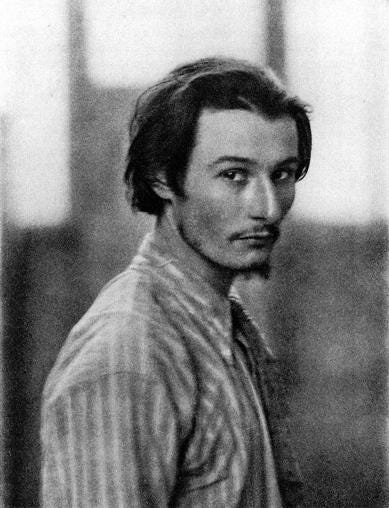
Somewhere around the time that I discovered the work of Gaudier-Brzeska, I also found out that he was a member of a rather interesting art movement. It was summer 2004, and we were at the Whitworth Art Gallery in Manchester, where they were hosting an exhibition called Blasting the Future! Vorticism in Britain, 1910-1920. I think this may have been my introduction to Vorticism, an avant-garde artistic and literary movement based in London, and Britain’s most significant contribution to the development of modernism. The exhibits were as exciting as their creators had no doubt intended, and I remember seeing some striking images of ships by Edward Wadsworth. Once again, the length of time that has elapsed makes it a challenge to remember most of it in any great detail, but a little research has filled in some gaps. There were works by all the major Vorticists, and also by Jacob Epstein and David Bomberg, who were not full members of the group but sympathetic to its aims, and by England’s only true Futurist, CRW Nevinson.
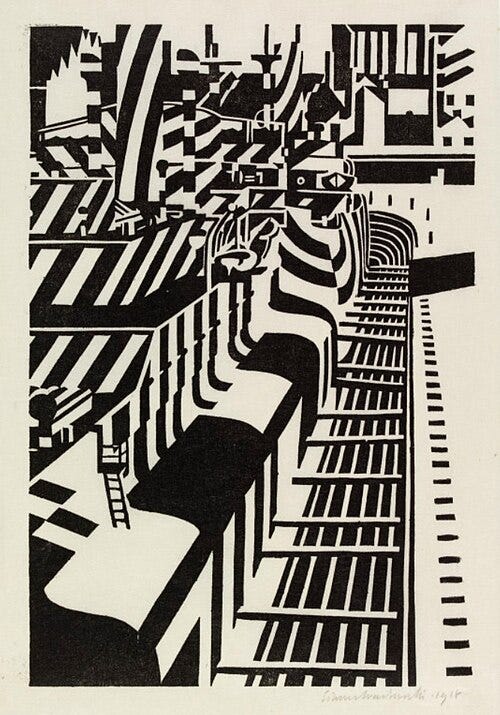
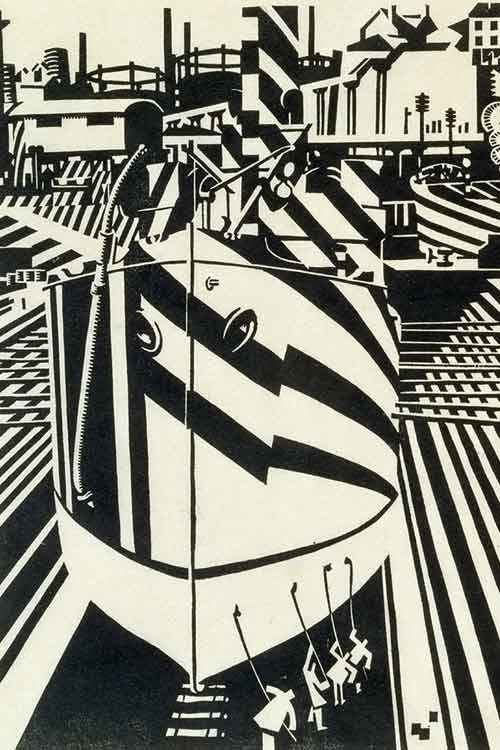
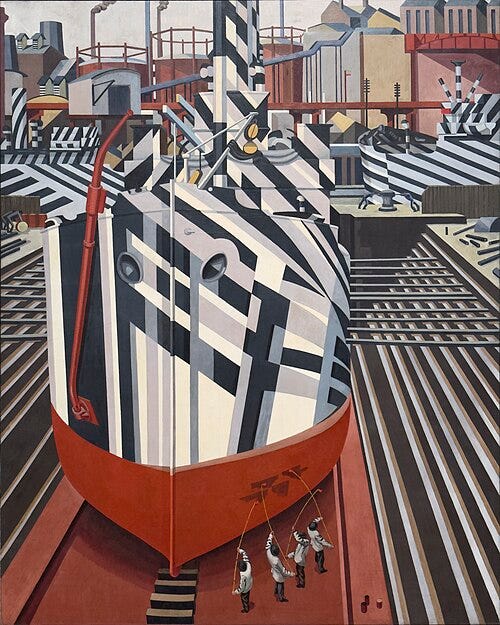
Founded by the artist and writer Percy Wyndham Lewis in 1914, the Vorticists had their origins in Expressionism and Cubism. In some ways they converged with the Italian Futurists, a movement led by Filippo Tommaso Marinetti that was active in London early in the century, but while they shared the Futurists’ fascination with dynamism and industry, they rejected their celebration of industrial advancement. In time Wyndham Lewis became hostile to the Futurists, and the British group consistently rejected comparisons, fiercely defending their independence. It was a turbulent and complex relationship.
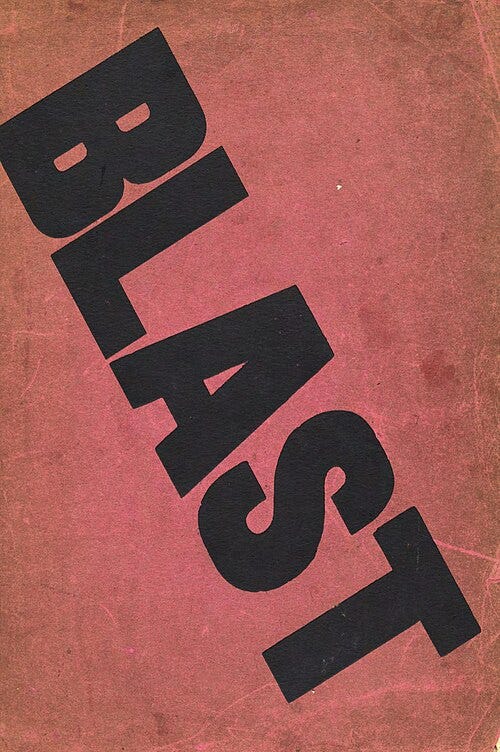
The Vorticist movement was driven by a loosely defined association of like-minded artists and literary figures. Central to the group were Wyndham Lewis, Gaudier-Brzeska and the American poet Ezra Pound. They had their own base, the Rebel Art Centre at 38 Great Ormond Street, which was a meeting place where they could share ideas, hold lectures and hang their work. Reacting against the Victorian era, they promoted a dynamic style of art that incorporated hard-edged, geometric, often abstract forms, combining Cubism with imagery of machines and the urban environment. They held an exhibition in London in 1915, and launched themselves with a magazine entitled BLAST. Primarily a literary journal, it included the work of writers such as Pound, TS Eliot, Rebecca West and Ford Madox Ford. It survived for only two issues, but contained two aggressive manifestos by Wyndham Lewis, ‘blasting’ British art and culture and proclaiming the Vorticist aesthetic: 'The New Vortex plunges to the heart of the Present – we produce a New Living Abstraction.’
Long Live the Vortex! was an introductory manifesto that listed what the movement was against (Futurism, Romanticism, Naturalism, Impressionism, etc.) as well as its objectives. Aiming not to effect change but to harness it, Wyndham Lewis wrote with capitalised conviction: 'WE ONLY WANT THE WORLD TO LIVE, and to feel its crude energy flowing through us.’ 'We stand for the Reality of the Present’, he affirmed, 'not for the sentimental Future, or the sacripant past.’
It all sounds very shouty, doesn’t it? It’s clear that the Vorticists felt that they had something vital and urgent to express, which makes the abrupt suppression of their work all the more poignant; a scything-down just as they were struggling to their feet.
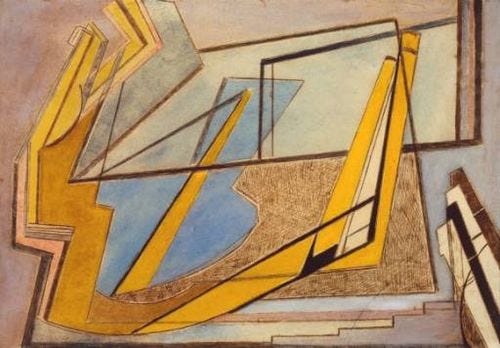
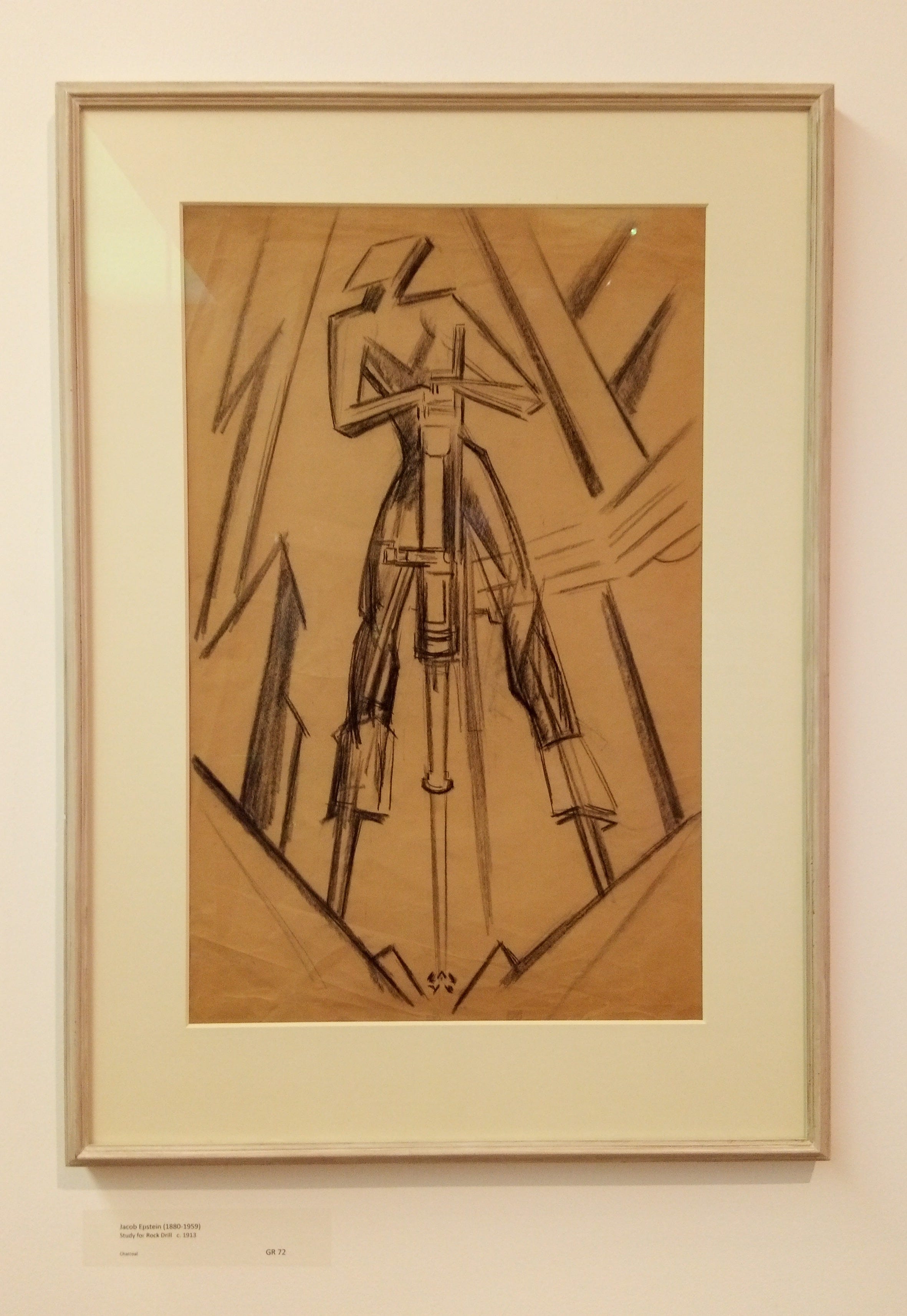
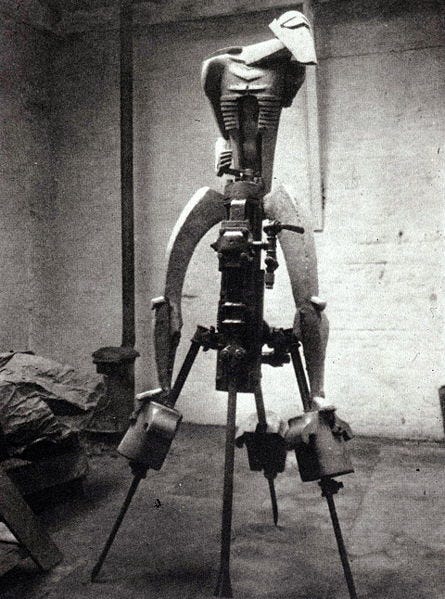
Artists formally involved with the Vorticist movement included Lawrence Atkinson, Jessica Dismorr, Cuthbert Hamilton, William Roberts, Helen Saunders, Edward Wadsworth and Gaudier-Brzeska. Bomberg, though not a member, produced major work in a similar style, as did Epstein, who was responsible for the striking Vorticist-influenced Rock Drill (1913), which is probably his most innovative work. The original piece consisted of a humanoid figure incorporated into an actual pneumatic drill; a cyborg man-machine; an industrialized quasi-human made of old fashioned plaster. The plaster figure was probably built to fit the drill, which it clutched in a somewhat intimidating manner, and the completed whole was realised as a ten-foot-high sculpture in 1915. The contrast between the white, matte plaster figure and the shiny black drill emphasized the difference between human and machine, despite their being connected.
Although Rock Drill began as a positive expression of power and strength, its creation foreshadowed a war where humans were crushed by machinery. After the death of Gaudier-Brzeska, Epstein dismantled the sculpture, discarding the drill and casting only the torso of the figure in bronze. What had begun as an optimistic representation of man and machine working together now suggested something utterly nightmarish. Epstein, whose own experience of the war led to a nervous breakdown, explained it as '… the armed, sinister figure of today and tomorrow. No humanity, only the terrible Frankenstein’s monster we have made ourselves into.’ This was undoubtedly an emotional reaction to the barbarity of war, the distress expressed by one of its traumatised victims, but was it also an accurate prognostication of the future?
You may have noticed that two of the Vorticist artists were not men. They were - you know - women. I shouldn’t be facetious: at least the Vorticists allowed women to join. The same cannot be said of the Futurists. Nevinson, for example, felt that it was most undesirable to include females, remarking to Wyndham Lewis, 'Let’s not have any of those damned women.’ Charming.
Until recently, the role of women in the formation of the movement has generally been ignored, but its base, the Rebel Art Centre, was funded by the painter Kate Lechmere, Wyndham Lewis’ lover at the time. She paid the rent, provided the soft furnishings and lent him money for the first publication of BLAST.
Painters Jessica Dismorr and Helen Saunders were somewhat overshadowed by the male members of the group, a fact illustrated in a painting made by William Roberts during the early nineteen-sixties. An imaginative, reconstructed scene entitled The Vorticists at the Restaurant de la Tour Eiffel: Spring,1915, it depicts male members of the group seated at a dinner, with the figures of Dismorr and Saunders in the background. It appears that they are not guests at the main meal, but are arriving in time for dessert - a rather obvious metaphor, I would have thought, and possibly a reflection of how female artists were regarded at the time, even by other members of their own movement.
Only two paintings from Dismorr’s Vorticist period survive. This is one of them:
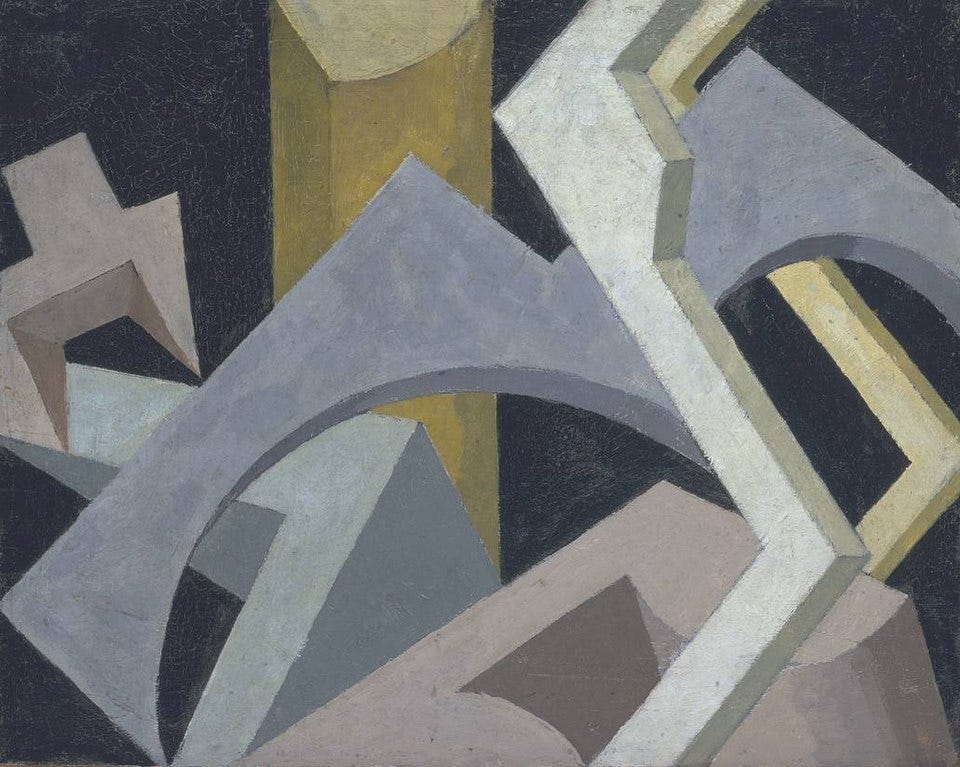
Though Vorticist in style, it differs subtly from other Vorticist work. Architectural shapes are suspended in space in a seemingly weightless environment. It is thought that after Dismorr’s death in 1939, her executor may have destroyed other Vorticist works by her because he thought they cast doubts on her sanity.
Although drawings by Saunders survive, most of her Vorticist paintings are believed to be lost, indeed the loss of Vorticist works in general is a recurring theme: two contemporary exhibitions, one at the Doré Gallery in London in 1915 and another at the Penguin Club in New York in 1917, included large-scale oil paintings by Wyndham Lewis, Edward Wadsworth and others. Almost all of them have been lost. In 2019 researchers at the Courtauld Institute of Art in London discovered that Wyndham Lewis had himself painted Praxitella (1921), a portrait of his partner, the pioneering film critic and curator Iris Barry, over Atlantic City (c.1915), a Vorticist work by Saunders. The reason for this reckless disregard of a fellow artist’s work can only be surmised, although they are known to have fallen out. Another example of that hot-blooded, Vorticist temperament, perhaps.
The Vorticist movement ended three years after it began, when many of its members were called to serve in the war. Another factor that contributed to its early demise was its alignment with aspects of Fascism, with its nationalistic overtones. The horrors of war brought about a rejection of the avant-garde in favour of more traditional art, a movement known as the Return to Order. Perhaps it was symptomatic of a need to embrace the familiar during a period of recovery, when an exhausted society had insufficient energy to engage with new cultural challenges. Wyndham Lewis made a brief attempt to revive Vorticism in 1920 with Group X. A collection of British artists, it provided a continuing focus for avant-garde art in Britain after the war, but like its predecessor it was short-lived. It is interesting to speculate what the trajectory of British art might have been without the suffocating hiatus imposed by the Great War.
They say that timing is everything. Of course it isn’t, but bad timing can be catastrophic, and the fate of the Vorticist movement demonstrates this. It was extinguished before it had time to realise its full potential, and it never regained its impetus. Having emerged just as the world was on the brink of a devastating war it could not last, yet it continues to be remembered as an exciting feature of Britain’s artistic landscape.
If you enjoyed this article and would like to help the publication, please hit the ❤️button. If you would like to subscribe or leave a tip, you can use one of the buttons below. Thank you for supporting human creativity.
Sources:
Christies.com Who were the Vorticists? by Alastair Smart.
tate.org.uk - Henri Gaudier-Brzeska; Vorticism; Return to Order.
estorickcollection Blasting the Future! Vorticism in Britain, 1910-1920.
Wyndham Lewis and Vorticism: Professor Paul Edwards Imperial War Museums video.
gallery.ca National Gallery of Canada.
arthistoryunstuffed.com Jacob Epstein and The Rock Drill by Jeanne Willette 19/2/16.
Helen Saunders and Jessica Dismorr - The Female Vorticists,Tateshots video presentation by Brigid Peppin.
Art channel, YouTube (artlyst.com) The Vorticists.
Courtauld YouTube channel, film and description A Modern Masterpiece Uncovered: Wyndham Lewis, Helen Saunders and 'Praxitella’.
A Shared Vision, The Garman Ryan Collection at The New Art Gallery Walsall.
poetry foundation.org 'Long Live the Vortex!’ and 'Our Vortex’ by Wyndham Lewis.
courtauld.ac.uk.
theartstory.org Vorticism.
Modernist Journals Project (modjourn.org) BLAST: An Introduction by Mark Morrison.
Image credits:
Image 7 from the author’s collection. All other images public domain, via Wikimedia Commons.
1, date and author unknown; 2 & 3, Victoria and Albert Museum; 4, National Gallery of Canada; 5, Wyndham Lewis; 6, Tate Britain; 8, Tate collection; 9, author unknown.
remember the pieces with any clarity, but I do remember the feeling, which was one of total absorption; a rare pleasure. I left with some reluctance, and was dismayed when I later discovered that the artist had died during the First World War, not long after he had made the items I had been admiring. I felt the tragedy of that very keenly.
The human cost of war is sickening, and the concomitant loss of talent in all fields makes the sum total of suffering and waste mind-boggling in its immensity. How many brilliant people, mostly men, have been slaughtered on the field of battle, and what might their contribution to human existence have been had they lived? Henri Gaudier-Brzeska was just one example. Whenever I encounter his work my heart sings, but the song is marred by a thrum of dread and sorrow, that terrible knowledge of a life stolen. He was killed in action in 1915 at the age of twenty-three.
Somewhere around the time that I discovered the work of Gaudier-Brzeska, I also found out that he was a member of a rather interesting art movement. It was summer 2004, and we were at the Whitworth Art Gallery in Manchester, where they were hosting an exhibition called Blasting the Future! Vorticism in Britain, 1910-1920. I think this may have been my introduction to Vorticism, an avant-garde artistic and literary movement based in London, and Britain’s most significant contribution to the development of modernism. The exhibits were as exciting as their creators had no doubt intended, and I remember seeing some striking images of ships by Edward Wadsworth. Once again, the length of time that has elapsed makes it a challenge to remember most of it in any great detail, but a little research has filled in some gaps. There were works by all the major Vorticists, and also by Jacob Epstein and David Bomberg, who were not full members of the group but sympathetic to its aims, and by England’s only true Futurist, CRW Nevinson.
Founded by the artist and writer Percy Wyndham Lewis in 1914, the Vorticists had their origins in Expressionism and Cubism. In some ways they converged with the Italian Futurists, a movement led by Filippo Tommaso Marinetti that was active in London early in the century, but while they shared the Futurists’ fascination with dynamism and industry, they rejected their celebration of industrial advancement. In time Wyndham Lewis became hostile to the Futurists, and the British group consistently rejected comparisons, fiercely defending their independence. It was a turbulent and complex relationship.
The Vorticist movement was driven by a loosely defined association of like-minded artists and literary figures. Central to the group were Wyndham Lewis, Gaudier-Brzeska and the American poet Ezra Pound. They had their own base, the Rebel Art Centre at 38 Great Ormond Street, which was a meeting place where they could share ideas, hold lectures and hang their work. Reacting against the Victorian era, they promoted a dynamic style of art that incorporated hard-edged, geometric, often abstract forms, combining Cubism with imagery of machines and the urban environment. They held an exhibition in London in 1915, and launched themselves with a magazine entitled BLAST. Primarily a literary journal, it included the work of writers such as Pound, TS Eliot, Rebecca West and Ford Madox Ford. It survived for only two issues, but contained two aggressive manifestos by Wyndham Lewis, ‘blasting’ British art and culture and proclaiming the Vorticist aesthetic: 'The New Vortex plunges to the heart of the Present – we produce a New Living Abstraction.’
Long Live the Vortex! was an introductory manifesto that listed what the movement was against (Futurism, Romanticism, Naturalism, Impressionism, etc.) as well as its objectives. Aiming not to effect change but to harness it, Wyndham Lewis wrote with capitalised conviction: 'WE ONLY WANT THE WORLD TO LIVE, and to feel its crude energy flowing through us.’ 'We stand for the Reality of the Present’, he affirmed, 'not for the sentimental Future, or the sacripant past.’
It all sounds very shouty, doesn’t it? It’s clear that the Vorticists felt that they had something vital and urgent to express, which makes the abrupt suppression of their work all the more poignant; a scything-down just as they were struggling to their feet.
Artists formally involved with the Vorticist movement included Lawrence Atkinson, Jessica Dismorr, Cuthbert Hamilton, William Roberts, Helen Saunders, Edward Wadsworth and Gaudier-Brzeska. Bomberg, though not a member, produced major work in a similar style, as did Epstein, who was responsible for the striking Vorticist-influenced Rock Drill (1913), which is probably his most innovative work. The original piece consisted of a humanoid figure incorporated into an actual pneumatic drill; a cyborg man-machine; an industrialized quasi-human made of old fashioned plaster. The plaster figure was probably built to fit the drill, which it clutched in a somewhat intimidating manner, and the completed whole was realised as a ten-foot-high sculpture in 1915. The contrast between the white, matte plaster figure and the shiny black drill emphasized the difference between human and machine, despite their being connected.
Although Rock Drill began as a positive expression of power and strength, its creation foreshadowed a war where humans were crushed by machinery. After the death of Gaudier-Brzeska, Epstein dismantled the sculpture, discarding the drill and casting only the torso of the figure in bronze. What had begun as an optimistic representation of man and machine working together now suggested something utterly nightmarish. Epstein, whose own experience of the war led to a nervous breakdown, explained it as '… the armed, sinister figure of today and tomorrow. No humanity, only the terrible Frankenstein’s monster we have made ourselves into.’ This was undoubtedly an emotional reaction to the barbarity of war, the distress expressed by one of its traumatised victims, but was it also an accurate prognostication of the future?
You may have noticed that two of the Vorticist artists were not men. They were - you know - women. I shouldn’t be facetious: at least the Vorticists allowed women to join. The same cannot be said of the Futurists. Nevinson, for example, felt that it was most undesirable to include females, remarking to Wyndham Lewis, 'Let’s not have any of those damned women.’ Charming.
Until recently, the role of women in the formation of the movement has generally been ignored, but its base, the Rebel Art Centre, was funded by the painter Kate Lechmere, Wyndham Lewis’ lover at the time. She paid the rent, provided the soft furnishings and lent him money for the first publication of BLAST.
Painters Jessica Dismorr and Helen Saunders were somewhat overshadowed by the male members of the group, a fact illustrated in a painting made by William Roberts during the early nineteen-sixties. An imaginative, reconstructed scene entitled The Vorticists at the Restaurant de la Tour Eiffel: Spring,1915, it depicts male members of the group seated at a dinner, with the figures of Dismorr and Saunders in the background. It appears that they are not guests at the main meal, but are arriving in time for dessert - a rather obvious metaphor, I would have thought, and possibly a reflection of how female artists were regarded at the time, even by other members of their own movement.
Only two paintings from Dismorr’s Vorticist period survive. This is one of them:
Though Vorticist in style, it differs subtly from other Vorticist work. Architectural shapes are suspended in space in a seemingly weightless environment. It is thought that after Dismorr’s death in 1939, her executor may have destroyed other Vorticist works by her because he thought they cast doubts on her sanity.
Although drawings by Saunders survive, most of her Vorticist paintings are believed to be lost, indeed the loss of Vorticist works in general is a recurring theme: two contemporary exhibitions, one at the Doré Gallery in London in 1915 and another at the Penguin Club in New York in 1917, included large-scale oil paintings by Wyndham Lewis, Edward Wadsworth and others. Almost all of them have been lost. In 2019 researchers at the Courtauld Institute of Art in London discovered that Wyndham Lewis had himself painted Praxitella (1921), a portrait of his partner, the pioneering film critic and curator Iris Barry, over Atlantic City (c.1915), a Vorticist work by Saunders. The reason for this reckless disregard of a fellow artist’s work can only be surmised, although they are known to have fallen out. Another example of that hot-blooded, Vorticist temperament, perhaps.
The Vorticist movement ended three years after it began, when many of its members were called to serve in the war. Another factor that contributed to its early demise was its alignment with aspects of Fascism, with its nationalistic overtones. The horrors of war brought about a rejection of the avant-garde in favour of more traditional art, a movement known as the Return to Order. Perhaps it was symptomatic of a need to embrace the familiar during a period of recovery, when an exhausted society had insufficient energy to engage with new cultural challenges. Wyndham Lewis made a brief attempt to revive Vorticism in 1920 with Group X. A collection of British artists, it provided a continuing focus for avant-garde art in Britain after the war, but like its predecessor it was short-lived. It is interesting to speculate what the trajectory of British art might have been without the suffocating hiatus imposed by the Great War.
They say that timing is everything. Of course it isn’t, but bad timing can be catastrophic, and the fate of the Vorticist movement demonstrates this. It was extinguished before it had time to realise its full potential, and it never regained its impetus. Having emerged just as the world was on the brink of a devastating war it could not last, yet it continues to be remembered as an exciting feature of Britain’s artistic landscape.
If you enjoyed this article and would like to help the publication, please hit the ❤️button. If you would like to subscribe or leave a tip, you can use one of the buttons below. Thank you for supporting human creativity.
Sources:
Christies.com Who were the Vorticists? by Alastair Smart.
tate.org.uk - Henri Gaudier-Brzeska; Vorticism; Return to Order.
estorickcollection Blasting the Future! Vorticism in Britain, 1910-1920.
Wyndham Lewis and Vorticism: Professor Paul Edwards Imperial War Museums video.
gallery.ca National Gallery of Canada.
arthistoryunstuffed.com Jacob Epstein and The Rock Drill by Jeanne Willette 19/2/16.
Helen Saunders and Jessica Dismorr - The Female Vorticists,Tateshots video presentation by Brigid Peppin.
Art channel, YouTube (artlyst.com) The Vorticists.
Courtauld YouTube channel, film and description A Modern Masterpiece Uncovered: Wyndham Lewis, Helen Saunders and 'Praxitella’.
A Shared Vision, The Garman Ryan Collection at The New Art Gallery Walsall.
poetry foundation.org 'Long Live the Vortex!’ and 'Our Vortex’ by Wyndham Lewis.
courtauld.ac.uk.
theartstory.org Vorticism.
Modernist Journals Project (modjourn.org) BLAST: An Introduction by Mark Morrison.
Image credits:
Image 7 from the author’s collection. All other images public domain, via Wikimedia Commons.
1, date and author unknown; 2 & 3, Victoria and Albert Museum; 4, National Gallery of Canada; 5, Wyndham Lewis; 6, Tate Britain; 8, Tate collection; 9, author unknown.
Showing my knowledge gaps again ! 😊.. Not heard of this movement, but enjoyed reading / learning about this Jules. Fascinating. Thanks for expanding my knowledge again Jules 😊 x
This was fascinating, Jules. Thank you for sharing this, which was all new to me. That photo of the artist at the top of the post is stunning. Sad that he died so young. War is such a waste of everything.